
Take-Home Sermon
Perfect Attendance at Worship, but Absent from Love?
Matthew 22:34–40 · Poong Sung Kwang Yeom Church
1Married Couples
Are we keeping our “share” of the rules in marriage while losing the love those rules were meant to serve?
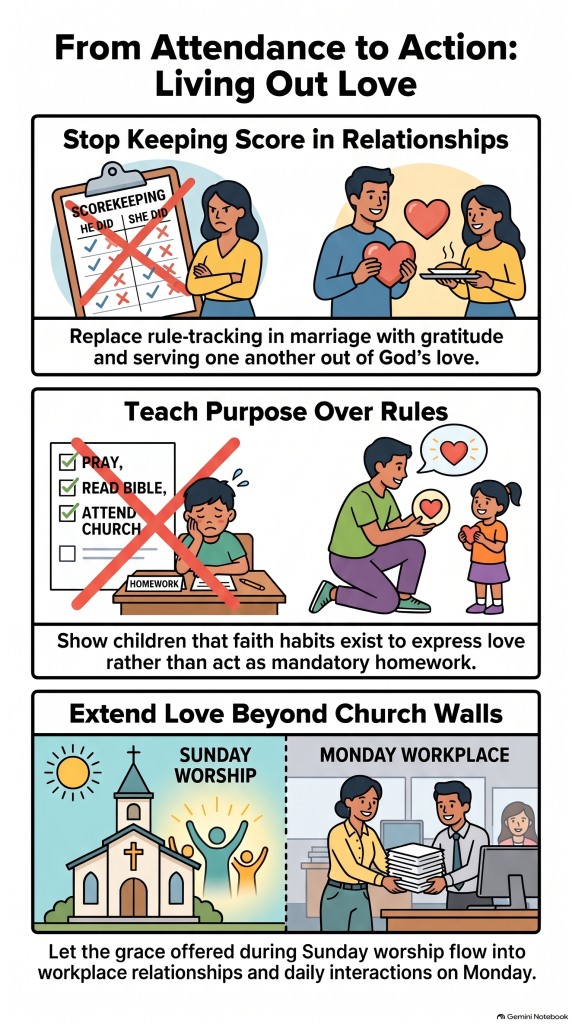
Who washed up, who looked after the children, who did more around the house. Like the children at the dinner table asking “who got up first?”, we can find that in the counting, the warmth between us quietly disappears.
The commandments show love the way to go; love is the destination they are heading for (Matt 22:40). Once we start keeping score, the rules are kept but the person disappears. Our nearest neighbour is the one sitting across the table.
“Before I count who has done more, let me be the first to say thank you.”
That we would stop keeping score, and serve one another out of the love we first received from God.
2Those Whose Spouse Does Not Share Their Faith
Am I hoping only that my spouse will come to worship?
When a spouse stays away from church, frustration can speak first: “Why won’t you come?” Love can then feel like pressure, and a spouse can feel left behind when the other is always at church.
Whoever loves God loves the person God has placed closest to them (1 John 4:20). A spouse of a different faith is also our neighbour. Love is passed on by how we live before it is passed on by what we say, and that person’s heart is known only to God and to them.
“Before I try to bring my spouse to worship, let me show love first through the way I live.”
That our spouse would meet God’s love not through our zeal but through our love.
3Parents of Young Children
Am I teaching my children the rules of faith first, or showing them first what it means to love God?
“Sit still in worship. Say thank you. Don’t fight with your brother.” Like me with the dinner-table rule, we can end up asking only whether the rule was kept.
Behind every rule is a purpose, and the purpose is love. Before you state the rule, tell them why: “We do this because we love God.” The first neighbours a child learns to love are brothers, sisters and friends.
“Before I tell my child to keep the rule, let me show them the love that the rule is for.”
That our children would learn worship and rules as the joy of loving God and others.
4Parents of Teenagers and Older Children
Do I only check my child’s attendance and habits of faith, and miss asking about their heart and their day?
If “Did you go to church? Did you read your Bible?” becomes all we say, a young person feels inspected rather than loved, and goes quiet.
Perfect attendance at worship with absence from love can happen in a household too. Love for God shows itself in how we treat those beside us. Faith that feels like homework is hard to love; faith met as the response of someone who has been loved is different.
“Before I check my child’s attendance, let me first ask about their day.”
That our children would meet faith not as homework but as the response of those who are loved, and that we would come to them in love first.
5Single Adults
Is the person I am on Sunday the same person my colleagues meet on Monday?
We serve eagerly at church, yet are sharp with a colleague, a flatmate or family. Sunday’s love and Monday’s patience can seem to belong to two different people.
Love of neighbour does not stay inside the church building. Leviticus 19 spells it out in the workplace: not delaying wages, speaking honestly, and not changing our standard according to who is in front of us. The colleague I find difficult is a neighbour I am called to love this week.
“Let the person I am on Sunday and the person I am on Monday not be different; let me be the first to reach out to one person beside me.”
That the love for God we offer in worship would flow into our workplaces and everyday lives.